
MATs
Reputation management
Centralisation


Knowing one of your schools is struggling with parents isn't much use. Knowing where it's struggling is.
Parent engagement metrics are some of the earliest warning signs that parents are dissatisfied or unhappy with their child's school. The same metrics can also reveal extra costs and extra staff hours, hiding within plain sight.
But which metrics are the ones worth paying attention to?
Here are five of the most important engagement metrics for MATs to monitor across every school... and how to identify the results that should make you reach out to the school to offer support.
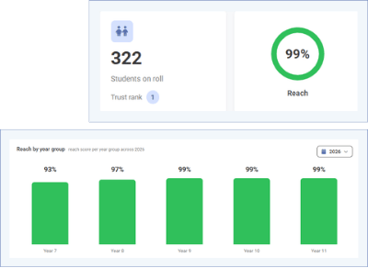
Tracking a school's reach in ReachMoreParents
Can each school communicate directly with every pupil’s family?
Parent reach measures the percentage of pupils for whom at least one parent is registered to receive communications from the school, whether that’s by email, SMS or parent app.
Measuring reach answers an important question: How many parents can your schools get in touch with via dedicated channels?
Many schools prefer to contact parents via their parent app. It’s less work for school staff, reducing duplication of messages across multiple channels like SMS or email, and for parents it means that all updates can be found in one place.
For MATs, the percentage of families not being reached can be more revealing than the percentage that is. If a 400-pupil school has 80 per cent reach, that leaves 80 pupils whose families cannot be contacted through its normal communication route.
Reaching those families may mean sending paper letters, making individual phone calls, checking contact details or tracking parents down at the school gate. This increases workload and cost, while making it more likely that families miss deadlines, events or important information — and later say, “Nobody told me.”
The higher a school’s reach, the fewer families staff must contact manually and the more efficiently it can communicate. It also gives more parents the opportunity to stay informed and involved, providing the foundation for stronger parent engagement and improved satisfaction.
Comparing reach across every school helps MAT teams identify where communication gaps are creating avoidable workload, increasing costs and putting pupils at risk of missing out.
But despite the ease of use for both schools and parents alike, just getting parents to register on a parent communication app is often a hurdle of its own. It's why in a recent blog, we tackled a question that schools have been asking for years: How do you get 100 per cent uptake for your parent communications app?
Are school messages and updates being read?
Parent interaction measures the percentage of registered parents who open and read messages and updates.
Registration is only the starting point. Reach tells you that a school can send a message to a parent but interaction tells you whether that communication is being read. A parent who is registered but rarely opens anything may be no better informed than one who never registered.
Low interaction is not necessarily a sign that parents do not care. It can indicate that communications are poorly targeted, sent too frequently, delivered at the wrong time or difficult to understand. If parents are repeatedly sent information that is irrelevant to their child — or bombarded with updates — they can become blind to messages, including the important ones.
When key communications go unread, staff may need to send follow-up messages, make phone calls, issue paper reminders or speak to parents at pick-up. Repeating messages adds workload and cost but can also contribute to further message fatigue.
No single open rate tells the whole story. Trust teams should look for sustained declines, differences between schools and messages that consistently receive lower interaction. They can then explore whether the cause is targeting, frequency, timing, content, accessibility or channel choice.
Improving interaction reduces the need for manual follow-up and makes it more likely that parents remain informed, meet deadlines and participate in school life. It also gives trusts an early opportunity to support schools before communication problems begin to affect parent confidence and satisfaction.
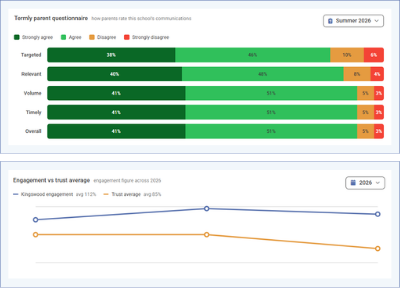
Measuring engagement in ReachMoreParents
How satisfied are parents with the way your schools communicate?
Engagement measures how satisfied parents are with school communications.
Satisfied parents are one of the strongest marketing tools a school can have. Positive word of mouth from other parents consistently ranks as one of the most influential factors families consider when choosing a school for their child. And being able to see and compare parent satisfaction rates across schools is a powerful way to predict where in your trust support might be needed.
Unlike reach and interaction, this metric is best measured by surveying parents directly. It’s a delicate balance to get right, because quizzing parents too often on their satisfaction runs the risk of annoying them — but up-to-date feedback is your best way to stay ahead of risks and opportunities for improvement.
A short questionnaire once a term is a reasonable compromise. Parents get the opportunity to share their feelings about the volume, relevance and timeliness of how your schools communicate and you get to see how each school is performing — it's a win/win.
Reach and interaction can both look healthy while parents are losing patience. A school can have every family registered and most of them opening messages, and still be sending too many notifications a week, half of them things nobody needed to know.
Only the questionnaire will tell a trust that. And when a school changes how it sends communications, next term's answers are the only way to know whether it worked.
And if you’re not sure what sort of communications schools should be sending to parents, creating a trust-wide communication strategy is a perfect place to start getting that clarity.
How intentionally do school staff use the platform?
Parents downloading and using your platform is only one half of the equation. If school staff are not using the platform well, parents will quickly stop relying on it too.
Measuring staff activity across every school in your trust is one of the best ways to make sure your platform is being used to its fullest potential. It's also one of the clearest ways to spot room for improvement: if one school is performing poorly on other metrics, it may be because staff activity is low.
It also goes the other way. Parents take their cue from staff: if updates are sporadic, or only from a few classes, parents learn that the platform isn't the place to get school news and go back to asking at the gate.
Low staff activity is usually the easiest of these problems to fix, because it is a training and habit problem rather than anything to do with parents. A term of measured posting for every year group is often all it takes.
Once staff activity becomes more consistent and intentional, metrics like parent interaction and engagement often go up. Staff no longer need to duplicate work across multiple channels and parents know where to go to check for key information and updates.
How do your schools measure up against each other?
For MATs, the power of measuring school engagement is being able to compare and rank schools.
Each of these metrics tells you more when you can see it across every school at once. A high sign-up rate for the parent communications app looks great until you check whether anyone's opening anything, at which point you discover parents download the app and then forget it exists. Busy staff making frequent updates seems great, but only if parents are reading them.
Comparison is where these metrics become useful. Once you have the same numbers for every school, the outliers do most of the work for you. A school scoring poorly across the board usually needs support rather than a difficult conversation.
And most importantly, a MAT that finds those school outliers early is identifying the problem while it's still small — and a simpler fix. Staff can be encouraged and trained on how to providing updates before they become burned out, parents can be signed up to the parent app and informed on how to use it before they lose trust in the school.
Centralisation offers MATs plenty of benefits, from greater oversight to more efficiency to the ability to scale. However, while most MATs now centralise HR, finance and other back office functions, parent communications remain entirely in the hands of the schools themselves.
But centralisation does not have to mean taking away school autonomy. Instead, it can offer the best of both worlds: the oversight to see each school’s most important parent engagement metrics in one place and the freedom for schools to curate and control their own communications.
81 per cent of MATs now centralise back office functions... but despite that, communications with parents often remain independent. As centralisation becomes more common, can MATs afford not to centralise communications too?