.svg)
Get the report
Want to know more about what schools and Trusts are saying about communications in 2026?


When we create our School Communications Report each year, we're looking for what's new, what's different and what surprises us.
This year's report was full of surprises.
One thing that didn't surprise us was how many schools said parent communications influence a school's image or reputation. That's something we've been talking about for a while - and it seems 85 per cent of schools agree with us.
But here's what we didn't expect: in 2026, schools are using communications with a purpose.
In fact, two-thirds of the 545 schools we surveyed (including nurseries, primaries, secondaries, independent schools and MATs) now have a formal strategy they use to manage their communications.
The amount of schools with a communication strategy wasn't the only surprise in the results. Even more surprising was the kind of schools with one.
Independent schools are more likely than others to have a communication strategy - and in fact, only 19 per cent of the independent schools we surveyed didn't have one.
And once we filtered independent primary schools out, the number of independent schools saying that parents not reading communications was their biggest issue dropped by 15 per cent.
Are the parents of primary school children just busier? Or is there something else at play here?
Whatever the reason, it's clear that engaging parents is a top priority for schools of every type. "Making communication simpler" for parents and "improving communication with parents" were the top two priorities for schools when choosing a communications system.
Making sure parents understand school communications and are willing to engage is something many schools struggle with - but it's worth the effort, for everyone involved.
For schools, the benefits of engaged parents are clear: less time spent writing emails, making calls or chasing paperwork. When communication takes place through one central platform, it can take hours off an administrator's workload each week.
But there's a benefit for families too. The research is clear: the children of engaged parents perform better in school. John Hattie's influential 2008 study found that the effect of parental engagement was equivalent to adding two or three years to a student's education.
Parental engagement pays off for parents and children too - so what's stopping parents from taking part?
When it comes to getting involved, parents feel overwhelmed and time-poor.
For example, when the Scottish government surveyed parents on how their child's school engages with them, six in ten said they were too busy with work to take part more in the life of the school. Others - particularly those from the most deprived areas - said a lack of confidence had an impact on their engagement. Meanwhile, EAL parents said that language barriers prevented them from being more engaged.
The 2026 report made one thing very clear: schools with a communications strategy engage more parents than those without. Strategy-led schools were more likely to set measurable parental engagement goals, and reported more confidence in the quality of their communications and parent experience.
Communications and a school's reputation amongst parents are intertwined - and as more schools begin adopting strategies that capitalise on that fact, those that don't may be missing an opportunity.
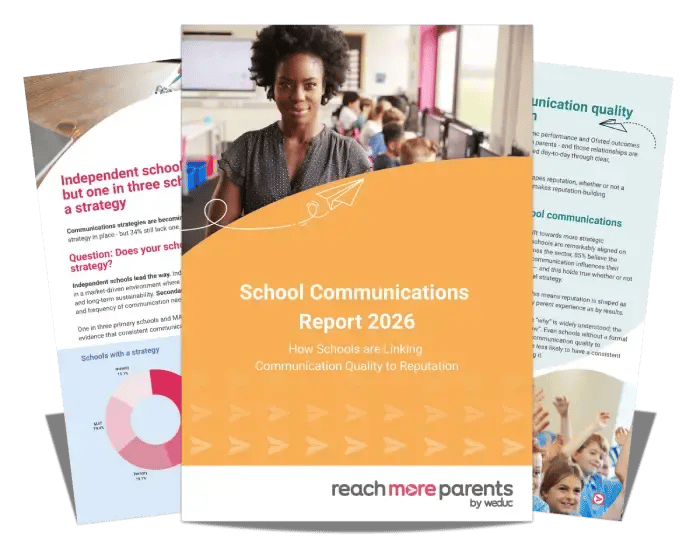
If you enjoyed this blog, there's more where that came from. Download the new School Communications Report 2026 for free to see insights like what communications goals schools are setting, what schools prioritise when choosing their communications platform, and more.
Want to know more about what schools and Trusts are saying about communications in 2026?