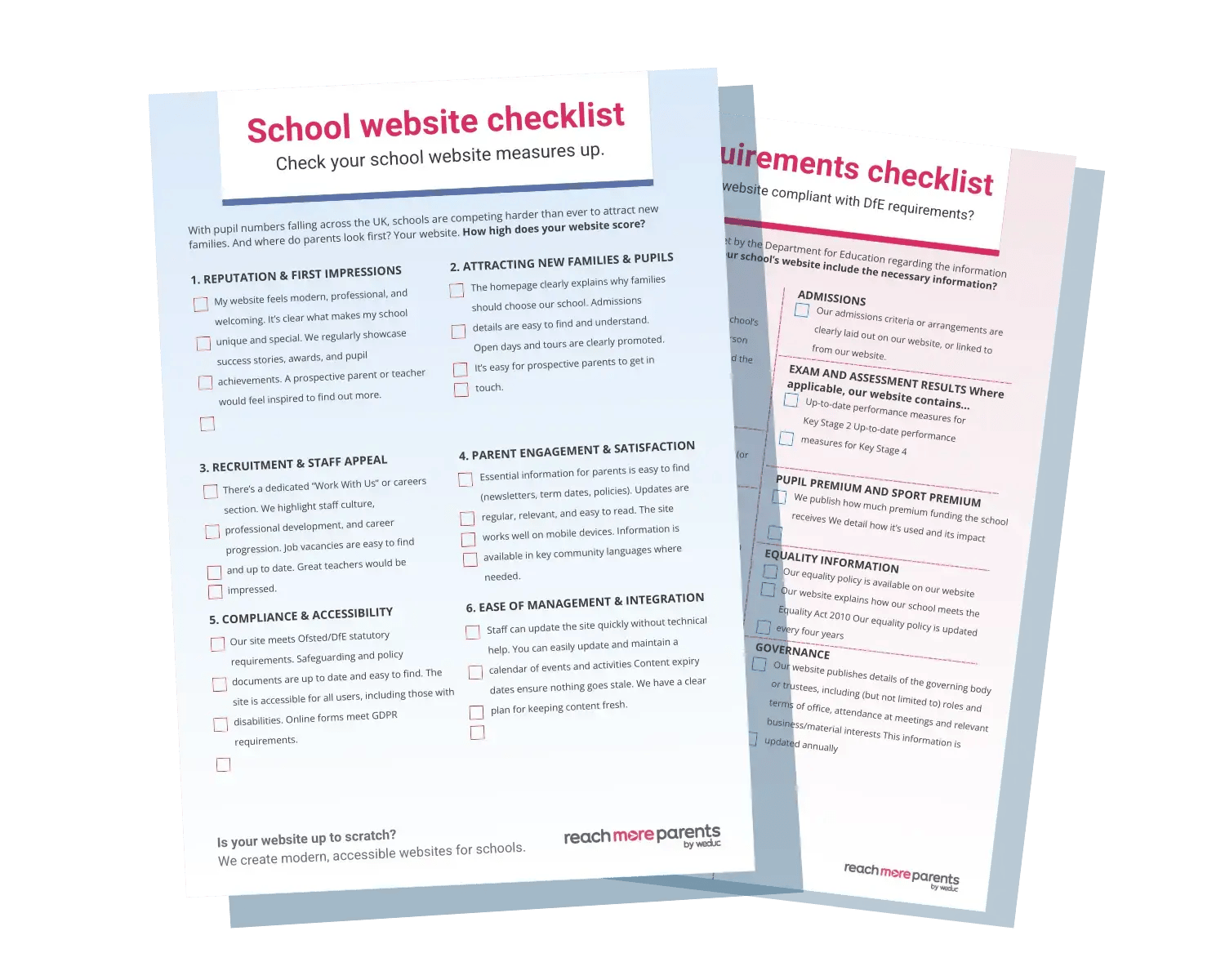
Get the school website health checklist
Check how Ofsted-ready your school's website is, with this quick checklist.


Is your school's website Ofsted-ready?
A school's website isn't just the first place prospective parents look, it's also one of the first places Ofsted looks when preparing a report on a school.
What do you make of the hypothetical school website pictured below? And how do you think Ofsted would judge it?
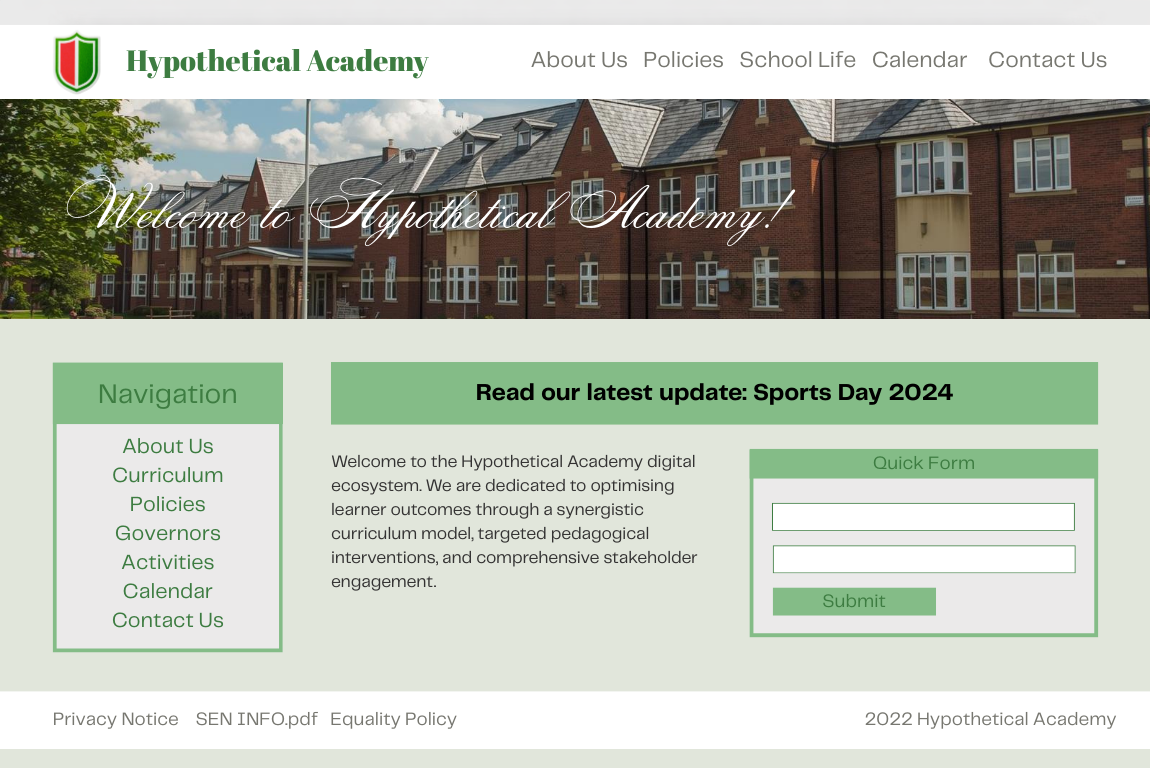 At a glance, this looks like a relatively typical school website. You might even say it looks competently designed - the colour palette is pleasant, the layout is simple and there are no glaring errors.
But there are errors.
In fact, there are many errors this website makes - ones Ofsted would immediately pick up on.
That's why many schools find their website being judged more harshly than they expected, because creating an Ofsted-ready school website is about more than just the basic mandatory content schools are legally obligated to include.
However, let's begin with that mandatory content - and then move forward to the more subtle errors schools make.
From what you must publish on your school's website to how your website should be designed, Ofsted audits school websites against the latest DfE checklist - and schools don't always realise that their own website is falling short.
The simplest way to keep track of what Ofsted expects from school websites is to break it down into "must have" and "nice to have". While the DfE has a publicly available checklist of the information schools must publish on their websites, Ofsted also audits for accessibility, usability and how often the site is updated.
Following the DfE checklist is essential, but for schools looking to achieve a glowing report, there is more a website can do.
However, since that DfE checklist is essential, it's a good place to start.
In 2026, the DfE expects school websites to include:
Up-to-date contact details (school name, postal address, telephone number, contact name, and the name and contact details of a school's SENCO - unless it is a special school)
School opening hours
The school's mission, vision and core values
Admissions information
Equality information
Policies, including safeguarding, complaints, uniform and behaviour
SEND information and report
Test, exam and assessment results
Curriculum details
Governance and financial details, including pay gap reporting
Pupil premium
PE and sport premium
Ofsted details, including either a copy of the school's most recent report or a link to the report on Ofsted's website
For secondary schools, careers programme information
An in-depth breakdown of exactly what to include can be found on the DfE's website.
The content might include everything Ofsted and the DfE want to see, but that is far from all school websites are judged from.
The way your school's website is designed can greatly affect its Ofsted judgment.
This does not mean Ofsted is looking for a snazzy, expensive website with all the newest design bells and whistles. What Ofsted expects from school websites is mobile friendliness, easy-to-use navigation, readability, compliance with web accessibility standards and recent updates.
What does this mean, in practice?
Mobile-friendliness
Mobile traffic now makes up 50 per cent of the web's activity (Statista). If your website is not mobile-responsive, half of your would-be visitors cannot use it properly. A mobile-friendly website adapts itself to work on a smaller screen - resizing its layout, text and navigation so it's still easy-to-use and readable without zooming or excessive horizontal scrolling. Mobile-friendly websites also may use a different file format for images: WEBP files load much more quickly and take up less bandwidth than JPGs or PNGs.
Easy-to-use navigation
When a website's navigation is easy to use, visitors can find the information and pages they're looking for quickly, without needing to click through a labyrinth of menus. It's obvious when something is clickable, and the structure of the site makes sense.
Readability
The gold standard for readability and accessibility are the Web Accessibility Guidelines (WCAG) - the same standards the DfE recommends schools adhere to.
According to WCAG, a readable website makes use of clear text which visitors can process without strain or confusion. For example, black text in 12 point Arial font on a white background is a good choice for a readable website. On the other hand, red text in a small and complicated script font on a pink background is going to be difficult, if not impossible, to read for most people.
 Of course, this is an extreme example. The majority of school websites are not opting for bubblegum pink backgrounds with bright red text. However, readability can be a more subtle issue than that.
.svg) These examples look identical to most human eyes. But the WCAG contrast checker tells us that while the left is acceptable, the right is not.
These examples look identical to most human eyes. But the WCAG contrast checker tells us that while the left is acceptable, the right is not.
Accessibility
Does your website meet Ofsted's inclusion standards? There are many ways a website can fail to be accessible: neglecting to use alt text for images, relying too heavily on PDFs, lacking proper heading structure, using jargon instead of clear English, or being impossible to navigate without a mouse. Ofsted looks for websites which can be used by everyone - including people who are using assistive technology.
Recent updates
Is your school website up to date? If the last time your policies were updated was three years ago, it's worth taking another look.
But Ofsted also looks for recent updates about the life of the school - blog or news updates about recent events and happenings. Could a parent get an idea of what your school has going on, just from browsing your website?
This is frustrating for some schools, because their website has been set up in a way which requires some technical know-how to update. How are you supposed to keep a website regularly updated when doing that means getting an external IT company on the phone? This is why, when we create websites for schools, we include easy-to-use tools for keeping them up to date.
Getting a school's website inspection-ready requires reviewing it with a keen eye. Remember our hypothetical school website? Here's some of the biggest errors it makes:
.svg)
Did you spot all of them?
More importantly, have you spotted any errors or missed opportunities on your own school's website?
Reviewing an entire website with compliance, content, design, accessibility and more in mind can seem like a daunting task. To make it easier, we've created a downloadable school website health checklist. It's free to download, and designed to streamline the review process. Download yours below, and get the review process started.
Check how Ofsted-ready your school's website is, with this quick checklist.