
Parental engagement
MATs
Reputation management
%20(1).webp?width=800&height=534&name=school-marketing-for-enrolment%20(1)%20(1).webp)

One of the most common topics in the UK's education sector is falling school rolls, and what to do about them. There is nothing school leaders can do to address population decline, so the obvious conclusion for many is that nothing can be done about declining pupil numbers either.
But that isn't true.
Or more accurately: it isn't true for every school.
As schools compete for smaller numbers of students, the schools that survive will be the ones with properly developed marketing strategies.
This does not mean shouting the loudest or spending the most on Google Ads. Generic advice like "Post a lot on Facebook" or "hold open days" is unhelpful - these are things schools are already doing.
What schools are not doing is using strategies tailored to their own context.
95 per cent of headteachers value diversity and inclusivity (Gov.uk, 2025). But what school leaders don't realise is how powerful their school's inclusivity can be when marketing to parents.
Parents of children with SEND have different priorities when choosing a school, with 39 per cent prioritising schools that offer good SEN support.
Many schools publish their SEN Information Report and assume that will be good enough for parents. The data says otherwise.
36 per cent of parents with children with SEND don't know whether their child's school has a SIR at all (Gov.uk, 2026). And those that do know about it often find it vague, unquantified or lacking in detail.
However, schools are not limited to providing information via just a SIR. Consider creating a dedicated page on your school website describing the SEN support available and answering the questions that matter to parents. Questions like: what resources, like quiet spaces or assistive technologies, are available? What experience do school staff have with SEN? How are children supported with activities like PE or school trips?
It isn't just school leaders who value inclusion, it's parents too. And those parents keep it in mind when they choose their child's school.
Picture this: a local family attends your school's open day. They look around, talk to teachers and seem to like what they see. Then they write their email address down on a form and disappear into the ether.
The more strategic schools follow up with an email to them later that week, sharing some more information and inviting them to enrol.
But even for those schools, that's where the strategy ends.
Parents typically attend more than one school's open day. The schools they remember are often the ones who nurture that relationship with them.
Nurture marketing is the practice of building a relationship with someone over time by staying in touch and giving them useful or relevant information. When they are ready to make a decision, they are more likely to think of you first.
Most schools do not use prospecting or nurture marketing. However, as the competition to fill places rises due to the decline in pupil numbers, that needs to change.
One follow-up email will not give your school any competitive edge. However, with prospecting tools, schools can begin nurturing families before they even attend the open day.
In practice, that could look like this: when families sign up for a school open day on your website, your prospecting tool stores that contact information for you. And suddenly a host of possibilities open up:
You can make families feel cared for by contacting them before open day with useful things to know, directions, parking information and more
You can ensure families remember you by contacting them after open day with answers to questions and follow-ups
You can track each family's journey rather than watching them vanish into the ether, measuring whether they came to the open day, whether they enquired further, whether they ever enrolled
You can measure how many open day places have been signed up for versus how many places you need to fill
Prospective families used to be vague, shadowy figures: schools knew they were out there but didn't know how many there were or how to reach them. That can change... and for many schools, it needs to.
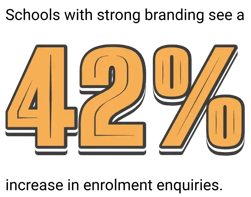
In fact, schools with strong branding see an average 42 per cent increase in enrolment enquiries (School Branding Agency, 2025).
Strong, consistent branding makes a school feel professional and recognisable, reassuring prospective parents that their child will be in safe hands.
The most impactful way to do this is by making sure that branding is consistent across every channel, from website to social media to emails to parent app.
When we launched our custom-branded parent apps, we knew it was something many schools and Trusts sorely needed. There are plenty of options for parent apps, but the ability to brand those apps with your own school's logo and colours is still a unique feature.
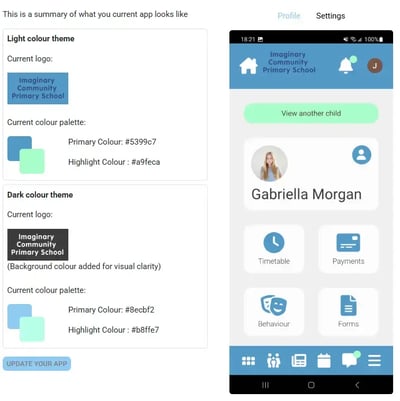 And something we hear from schools again and again is that branded apps increase trust with both current and prospective parents.
Current parents are more likely to download a custom app than a generic one. Uptake among parents is consistently higher for schools and Trusts with their own custom app.
However, what stands out is that custom apps also have an effect on prospective parents.
We've previously talked about how parent experience and word of mouth is one of the biggest factors influencing how new parents choose schools. Statistics show that this is true for every type of school, from small rural primary schools to big private schools in urban centres.
Consistent branding, including custom apps, communicate something important to prospective parents: This school cares about parent experience. This is a school that makes sure its communication is clear, easy to find and easy to understand.
We saved the most powerful school marketing strategy for last: word of mouth.
Marketing is expensive - and many schools struggle to find the budget for it while neglecting their most powerful marketing tool.
The data is very clear: prospective parents value the opinion of a school's current parents. When we analysed the statistics, we found that a school's reputation had a bigger effect on parent choice than Ofsted ranking, league tables or exam results.
What would your school's current parents say about you?
Would it be positive?
Would they recommend the school to other parents?
The most successful schools and Trusts have made their current parents into their strongest advocates. Those parents do their marketing for them, by telling other parents in the community what a great school it is.
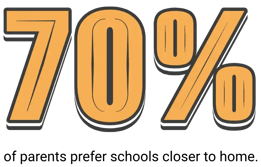
Parents consistently say that when it comes to choosing a school, location is a top priority. According to the Gov.uk "Parent, pupil and learner voice" in 2025, 70 per cent of parents prioritise schools closer to home.
For school leaders, this represents both a problem and an opportunity.
It's a problem because schools cannot physically move. No school leader can neatly package up his or her school, carry it four miles, and put it down in a better location.
However, what school leaders can do is make sure they reach every potential family who might see the school's location as an asset.
In practice, the most efficient way to do this is with hyper-local PPC like Google Ads.
Many schools already use Google Ads - but few use it with purpose. Ranking high for a search term like "primary school in Leicestershire" is a waste of effort for 99 per cent of schools in a county. Families want to see schools within one to three miles of their home - while your school might be 30 or 40 miles away, despite being in the same county.
Instead, think smaller.
Keyphrases like "primary school near me" or "primary school within 2 miles", targeted to a two-mile radius of your school's post code, can open up an audience who are already looking for you and your school.
Here's the good news: schools can influence how parents talk about them. Our blog on building reputation through communication breaks down exactly how parent experience impacts word of mouth.
The uncomfortable truth is that generic marketing efforts give parents no real reason to choose one school over another. If your open day looks like every other school's open day, and your social media sounds like every other school's social media, you're not competing, you're just blending in. Standing out requires strategy, not just activity.
Declining pupil numbers are not a foregone conclusion. Read our guide on attracting more pupils for real, data-led strategies to increase pupil intake.