


Measuring how staff communicate with parents can tell your trust more about parent engagement than you realise. Understanding how staff are communicating across your schools means you can spend less time guessing and make more informed decisions about what needs to improve.
A parent’s experience of communications within your trust depends on the school teams delivering them. When messages are inconsistent or updates are hard to find, that parent experience can become patchy and frustrating.
Staff can become frustrated too. Updates may need to be duplicated across three, four or even five different channels, with parents replying across all of them. With so many different channels being used independently of each other, staff can lose track of what has been posted where and when – and when parents ask where to find something, staff may find themselves digging through archives to track it down.
For trusts, all of this might go unnoticed. Central teams are often based away from their schools, so these day-to-day frustrations don't always reach them. But out of sight doesn’t have to mean out of mind.
How to measure staff communications activity
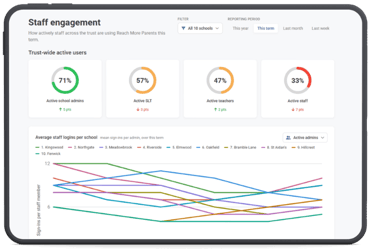
ReachMoreParents' trust-wide staff engagement dashboard
For trusts, measuring staff communications activity means looking at how staff communicate with parents. Are they still sending updates by email? Are they posting the same information in several places? Are they posting too often — or not often enough?
Those behaviours tell you much more about communication effectiveness than simply knowing how many people have access to the platform. They can show where staff are confident and where they may be struggling or need extra support.
The importance of clear roles
One of the most important parts of any communication strategy for trusts is defining who posts what and when.
Who is responsible for posting classroom updates on the parent communication app? Who creates the regular newsletter and sends it to families? Who is in control of emergency and crisis messaging? Who owns branding, content templates and other reusable assets?
When roles and responsibilities are unclear, staff may hesitate to post content or updates that parents want or expect. Alternatively, some staff members may take all of the responsibility themselves, leading to burnout and resentment. Creating clear roles means no one person is doing all the work.
For trusts, creating trust-wide templates and assets to help staff streamline communications can also free up time and reduce work duplication. Instead of spending an hour writing and reposting the same content to a school’s parent communication app, website and social media pages, a staff member can spend five minutes using a trust-created template to kickstart the same content, then post to all the school’s channels at once through automated widgets – such as our own multiposter inside the ReachMoreParents platform.
Look beyond parent engagement
Start measuring staff communications activity alongside your parent engagement data. Look at which channels staff are using, how often they’re communicating, where messages are being duplicated and whether there are noticeable differences in practice across your trust’s schools.
Use what you find to tighten your trust’s communications. Set clear expectations around channels, frequency and responsibilities, provide shared templates and resources where they will save staff time, and address it when staff are reverting to other ways of working.
Then keep measuring. Staff communications activity shouldn't be a one-off check – it should give you an ongoing view of whether your communications work in practice, where work is being duplicated and what needs to change.
The more clearly you can see both sides of the communication journey, the easier it is to make targeted improvements that benefit staff and families alike.
Measuring staff communications activity is just one piece of the puzzle. Read our blog on the five parent engagement metrics every trust should be monitoring.